
In 1937 John Cage enunciated his credo on the future of music. “Wherever we are, what we hear is mostly noise,” he wrote. “When we ignore it, it disturbs us. When we listen to it, we find it fascinating. The sound of a truck at 50 m.p.h. Static between the stations. Rain. We want to capture and control these sounds, to use them, not as sound effects, but as musical instruments.”[1] The 25-year-old composer’s words were subversive; he proposed almost nonchalantly to transgress – indeed, erase – the boundary between music and its other that gave music meaning and authorized its aesthetic value in 20th century America.
Cage’s most significant and infamous transgression was 4’33”, first performed in 1952 at the Maverick Concert Hall, a semi-enclosed outdoor auditorium near Woodstock, NY. At the premiere recital, pianist David Tudor sat at the piano on the stage, lifted the lid from the keys, started a stopwatch and did not play for four minutes and thirty-three seconds. It has been described as a joke and four-and-a-half minutes of silence. But Cage himself rejected both of these descriptions. He was deadly serious and there was, after all, no silence. The audience was listening for music, but they heard the noise of the woods around the concert hall, the insistent ticking of the stopwatch… and their own nervous fidgeting.
At one level, nothing is easier to understand than the difference between music and noise. We listen to music and, as Cage suggests, we hear noise. For most of Western history, music has been inseparable from order, whether it is the music of the spheres, the aural expression of the mathematical order underlying the universe, or the work of a Mozart, whose genius and rationality allow us a glimpse of perfection.
Noise is just as straightforward. It is an irritant, the radio static that, in Herman Hesse’s Steppenwolf, interferes with Harry Haller’s enjoyment of Mozart’s genius. Noise is the jackhammer outside your apartment at six in the morning. When you cranked up the stereo in your bedrooms to listen to the music of Little Wayne, Nirvana, The Clash or the Rolling Stones, your parents shouted over the din to “turn down that noise.” The composer Edgard Varese famously noted that “subjectively, noise is any sound one doesn’t like.”
These definitions suggest that music and noise are two sides of the same coin. They are both sound; one good one bad. One man’s meat is another man’s poison, but that doesn’t say much about the substance of either meat or poison, except that it has something to do with rationality one hand and disorder on the other.
There is an alternative way to understand noise: not as sound, but as the interruption of sound and, more specifically the sensory space of interrupted sound. Noise, I argue, is a rhetorical category – an ekphrasis, in effect – that has a modern history. I am not saying that there was no pre-modern noise, but that the noise has a specific meaning in modernity. And the aesthetic revolt initiated by Cage and the avant garde composers he inspired in the 1950s and 1960s only becomes fully intelligible when we consider that meaning.
A peculiar property of sound is that it has volume, both in the sense of its amplitude and the space that it occupies, as physicist Hermann von Helmholtz noted in 1862. “By each train of waves of sound, the density of the air and position of the particles of air are temporarily altered,” he wrote.[2] And that materiality is fundamentally a function of the space it inhabits. Sound could not be understood – literally made no “sense” – outside of the space in which it was produced and transmitted.
This idea formed the basis of a science of acoustics that emerged at the beginning of the 20th century. As Emily Thompson writes in The Soundscape of Modernity, acoustic science and engineering sought to produce something she calls “modern sound.” What made it modern was two things, first the lack of reverberation that might interfere with the signal – whether that was speech or music. This was sound in the purest possible form that science and engineering could produce, stripped of its inefficiencies. Thompson writes that “It both constituted and signified the efficiency of the spaces in which it was heard.”[3] It was also modern in that it embodied the highest goal of modernity: as economist Simon Patten proclaimed in 1905, the full employment of modern man’s rationality to “hasten his dominion over nature.”[4]
While the properties of sound in enclosed spaces had been a topic of considerable interest to musicians, impresarios and auditorium designers throughout much of the 18th and 19th century, it entered the modern age when in 1895 Harvard University engaged physics professor Wallace Sabine to improve the appalling acoustics of a newly-built lecture hall.[5] Eschewing the subjective and qualitative approach employed by his predecessors, Sabine mobilized all of the rational and technological tools then at his disposal to measure the acoustical properties and reverberation of the hall with exacting precision.
Following additional experiments with sound dampening treatments and adjustments to the auditorium’s interior architecture, Sabine concluded that reverberation, the persistence of sound long after the source has sounded, was the culprit and the space that contained it was the cause. The audibility of a sound, he wrote, depends “to a very large degree on the volume of the space and on the material of which the walls are composed.”[6] The acoustic properties of sound were, in effect, inseparable from the space that contained it. Sounds could thus be controlled by isolating and controlling the auditorium space.
Acoustic space was invariably defined in a rhetoric of control. Acoustic scientists began speaking of “sound fields” in the early 1930s. The “sound field” had a highly-specific meaning; sound might have a spatial existence, but that space was explicitly enclosed and contained. Lamenting “the difficulty of obtaining a convenient location, sufficiently free from extraneous noise” in an uncontrolled environment outside of the laboratory, E.H. Bedell of Bell Telephone Laboratories designed a “free-field” laboratory to isolate the “sound field.”[7] In constructing a facility that would make the “sound field” intelligible, investigable, and therefore real, “the important thing is the degree of departure from open air conditions.”[8] Not only was sound inseparable from space, but the space – enclosed and controlled – defined the “sound field.”
While sound needed to be contained, rational acoustical management and design excluded noise. External to acoustic order, there was no room for it in the sound field. Sabine railed against what he called “confusion of sounds.” Control of resonance in a sound field would only succeed, he wrote, if noise were kept at bay. “Confusion may arise from extraneous disturbing sounds – street noises and the noise of ventilating fans.”[9] Bell built Bedell’s laboratory to study free sound fields not only to isolate a given space of sound, but also to address the difficulties that had made free-field experiments impractical – namely obtaining a location “free from extraneous noises.”[10]
By the mid-1930s, the exclusion of “extraneous” noise had become a central trope in the discourse of “modern sound.” The science of acoustics sought to produce and maintain a coherent aural order – free, Sabine noted, of confusion – but noise interrupted that order. From an acoustical perspective, noise was antagonistic to and independent of coherent sound. A new term crept into the acoustical lexicon following the Second World War, the “noise field.” Sound was ordered, safe from the confusion of “extraneous noise,” and contained in the space of the “sound field” behind protective barriers of soundproofing insulation, but noise was understood as an “acoustic radiation pattern” emanating from a free-standing source.[11] It was autonomous rather than contained, and it produced its own space.
This was a space of danger. Noting that noise “is an unavoidable by-product of the power of modern machinery,”[12] University of Chicago researchers who conducted a study for the United States Navy in 1952 nonetheless listed a catalogue of alarming effects. Some, like difficulties of verbal communication, “aural pain” and temporary and permanent hearing loss, were already well known. Others, however, were startling. Exposure to an intense noise field produced “vertigo, nausea, nystagmus and visual field shifting, feelings of forced movement, staggering and falling.”[13] EEG experiments found that high intensity noise blurred vision, caused muscle weakness, lost coordination and the “activation of the adrenal stress mechanism.”[14] Not only that, the researchers observed that exposure to an intense noise field could result in the “impairment of higher brain functions” in subjects and the emergence of “mild or severe neurotic symptoms.”[15]
There is something of a paradox here: noise, the interruption of sound, also interrupts rationality, yet it is the necessary and inevitable byproduct of the technological modernity that rationality has produced. The noise field is aural space, but of a particular kind. It is abject space.
In Powers of Horror, Julia Kristeva narrates an encounter with a corpse on a mortuary slab, where she beholds “the breaking down of a world that has erased its borders: fainting away.”[16] The cadaver is the embodiment of the abject, that part of the self that is violently ejected in the production of subjectivity. It is the maternal body, sloughed off at the moment of birth, sustaining food produced apart from the self but necessary to its survival, and the urine and feces that our bodies produce but which we quarantine and hold apart as a polluted other.
And then there was the noise. Raw, undisciplined, seemingly uncontrollable, it was everywhere in the postwar years; the unavoidable byproduct of the technologies that defined postwar affluence. Noise fields overlapped the home and workplace, producing abject space. Seeping across the boundaries of aural order, even for a moment, they disrupted rationality. Yet transgression also promised and ecstatic liberation.
Inter-war modernist composers, like their literary colleagues, had used jarring sounds before. The Italian Futurist Luigi Russolo had called for an Art of Noises in 1913. George Antheil had a part for an airplane engine in Ballet Mecanique, and Varese included New York Fire Department sirens in Ionisation in 1933. But like the sound of the dynamo at the centre of Hart Crane’s poem The Bridge, these were all sounds that meant something. They were what R. Murray Shafer calls “sacred noise,” sounds full of meaning that signified the 20th century’s technological sublime.
Familiarity bred contempt – or at least visceral revulsion. By the end of the Second World War, with the increasing automation and mechanization industry and the ubiquity of what newspaper ads called “modern conveniences,” like, washing machines, cars and jetliners, these sounds were no longer exceptional. The technological sublime had become the technological mundane, and the sounds of modernity had become evacuated of meaning.
Not surprisingly, the most prominent American composers of the immediate post war years promoted an aesthetic of control. Antheil, Varese and their colleagues had been self-consciously independent artists who resisted organizations. In contrast, the composers of the postwar musical establishment were salaried intellectuals employed as academic specialists at a time when government was increasingly seeing education and culture as strategic resources in the Cold War. They enjoyed a near-monopoly of state and corporate funding and access to performance venues. Their musical culture that celebrated machine rationality as they sought to produce sound “as sound itself,” rationalized and reduced to its essentials.[17]
Roger Sessions, Milton Babbitt, his colleague at Princeton University, and Vladimir Ussachevsky and Otto Luening at Columbia, shaped the academic musical aesthetic of the 1950s. Sessions worked in a rigorous and demanding compositional idiom subjected the tonality, rhythm, amplitude and duration of each note to strict mathematical organization. By the 1950s, this extreme serialism had become the defining style of American academic music. Indeed, Sessions wrote that “[t]he serial organization of tones must be, and for the most part is, today regarded as a settled fact.”[18]
Babbitt penned a kind of manifesto for that project in a somewhat peevish article published in the February, 1958 issue of High Fidelity under the title “Who Cares if You Listen?” In it, he called for music that “employs a tonal vocabulary which is more ‘efficient’ than that of the music of the past, or its derivatives.” It was an art of total control, which had “created the need for purely electronic media of ‘performance.’”[19]
This was a Taylorized musical aesthetic with ambitions to tame music in the same way that acoustical science tamed sound and rationalized management sought to tame industrial production. A revolution in electronics, stimulated by the mobilization of the wartime economy gave the academic composers plastic control of all of the sounds of modernity. The establishment of sound and music research institutions like the Columbia-Princeton Electronic Music Center, with lavish funding from the Academy, government and corporations, gave them the opportunity.
Magnetic tape technology, introduced in 1945, allowed composers to rationalize and bend sounds and recontextualize them to their will. But they could only work on existing sounds that inevitably signified their means and context of production. No matter how much Luening might distort and alter the sound of a flute in Low Speed it was still the sound of a flute. Complete control demanded perfect sound, and this was made possible with the invention of the electronic synthesizer by RCA in 1955.
RCA soon donated its second, massive prototype synthesizer to the Columbia-Princeton Center, to be used by Ussachevsky, Babbitt and Sessions to analyze and dissect sound to create a new, completely rational, completely modern music untouched by human hands. It was perfect music for the modern age – sound without confusion or interruption. “When the curtain went up last night at the McMillan Theatre, the stage was bare save for six acoustic suspension loudspeakers,” The New York Times’s Harold Schonberg wrote of one of their concerts in 1961. “The audience looked at the speakers. The speakers looked back at the audience. The audience broke into applause. The speakers did not applaud back. We have finally arrived at music without performers.”[20] The aural abject had been quarantined, isolated and sanitized.
Yet the boundary between the subject and its abject is never absolute: the infant desires its mother, the adult desires food. Feces and urine, certainly the orifices that produce them, are sources of sexual fascination. And it is that moment of fascination and thrall in which the subject reproduces itself by enforcing that boundary between “I” and “It,” but also faces the prospect of its own annihilation should desire give way to transgression.
The academic-corporate modernists were not alone. A cohort of avant garde composers emerged alongside them that rejected the establishment’s rhetorics of control at the same time as they challenged a modernist orthodoxy founded on the heroic artist-technician and the institutional environment.
Most, like Cage, La Monte Young and, later, Terry Riley, operated either at its margins, or outside of it altogether. They were freelancers, dependent on the reception of a broader, non-institutional audience for their livelihoods. In that way at least, they articulated the modes and practices of the first generation of American modernist composers like Antheil and Varese.
However, while the latter deployed the signals of modernity the new composers embraced its keynotes in a critique that subverted the order and meanings of postwar modernism. They interrupted sound with a music that supplanted hearing for listening and opening up an aural space that replaced discipline and order with indeterminacy and play. Cage gleefully wrote to composer Virgil Thomson that his Quartet in Four Parts would “demonstrate that no sounds are forbidden even the most familiar.”
Three years later. 4’33” took that even further. A music audience sat in a music concert hall, listening for music but hearing not music. It was an invitation for the listener to stop listening and start hearing; to fearlessly surrender cognition for resonance. “But this fearlessness only follows if, at the parting of the ways, where it is realized that sounds occur whether intended or not, one turns in the direction of those [the composer] did not intend,” Cage wrote in 1955, auguring the coming aural and aesthetic revolt.[21]
Gratefully acknowledging their debt to Cage, the avant garde composers of the 1960s rejected the distinction between sound and noise. They deployed a variety of forms and non-forms, like sounds assembled by chance and part orchestrations, as with Riley’s In C, that changed with every performance. The process music of Alvin Lucier and Steve Reich manipulated sound, using phase-shifting and tape-delay to accentuate resonant frequencies and sideband harmonics. Lucier’s 1969 work “I Am Sitting in a Room” erased the performer – reciting a text – in the resonance of the space in which the performance was held. Lucier would note: “I was interested in the process, the step-by-step, slow process of the disintegration of the speech and the reinforcement of the resonant frequencies.”[22]
This ultimately was Cage’s legacy: the transgression of aural boundaries into abject space – but this is not as a space of danger, but of possibility and jouissance. The goal was to liberate music from the straightjacket of order, and the listener from the straightjacket of his or her own subjectivity.
What then is the purpose of writing music, Cage rhetorically asked in a 1957 essay, though he could equally have asked what was the purpose of hearing music. “One is, of course, not dealing with purposes but dealing with sounds,” he wrote. “Or the answer must take the form of paradox: a purposeful purposelessness or a purposeless play.” The play was not meant to impose order or rationality, “but simply a way of waking up to the very life we’re living, which is so excellent once one gets one’s mind and one’s desires out of its way and lets it act of its own accord.”[23]
***
Presented to the 24th Stony Brook University English Department Conference, Stony Brook University, New York, NY, 25 February 2012
***
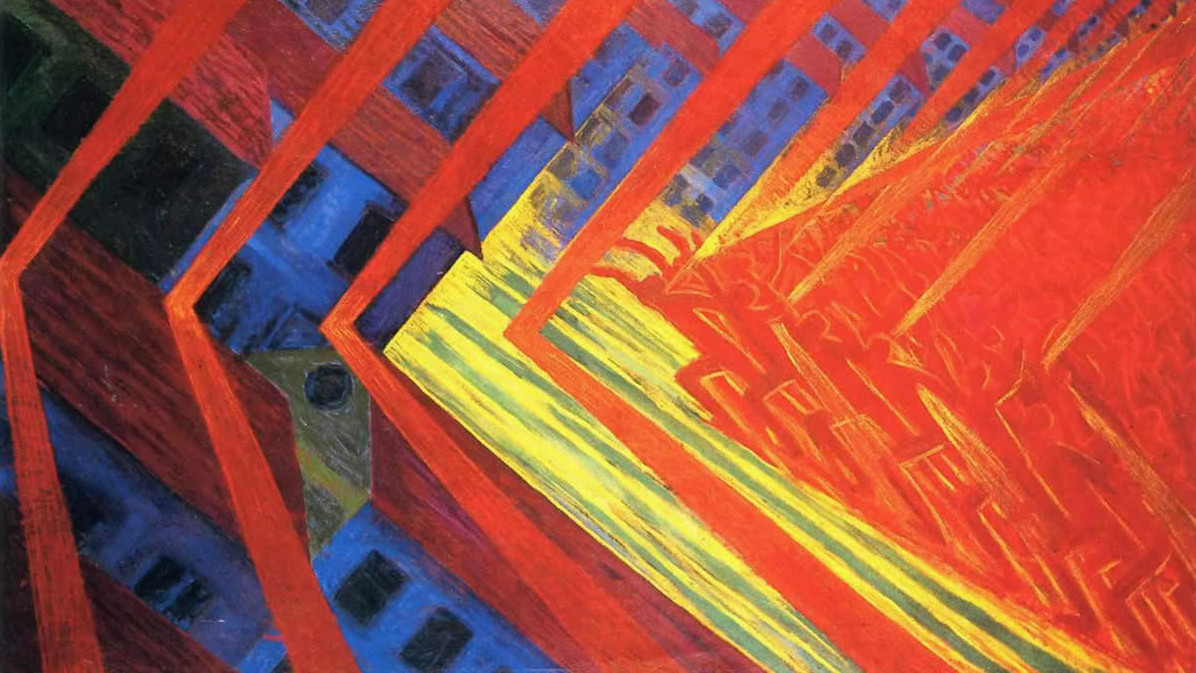
Title Image: Luigi Russolo, La Rivolta, 1911
[1] John Cage, “The Future of Music: Credo,” in Silence, paperback edition (Cambridge: MIT Press, 1966), 3.
[2] Helmholtz, 27.
[3] Thompson, 171.
[4] Simon Patten, The New Basis of Civilization (London: Macmillan & Co., 1907), 26.
[5] Thompson, 34.
[6] Sabine, 114.
[7] E.H. Bedell, “Some Data on a Room Designed for Free Field Measurements,” Journal of the Acoustical Society of America 8, October 1936, 113.
[8] Bedell, 114.
[9] Sabine, “Reverberation,” 13.
[10] Bedell, 118.
[11] H.W. Ades et al., BENOX Report: An Exploratory Study of the Biological Effects of Noise, The University of Chicago, 1 December 1953, 24.
[12] Benox Report, 7.
[13] Benox Report, 71.
[14] Benox report 77.
[15] Benox Report, 108.
[16] Kristeva, 4.
[17] Alice Shields to Matthew Friedman, E-mail, 7 October 2007, 1:43 AM.
[18] Sessions, 514.
[19] Milton Babbitt, “Who Cares if You Listen, “ High Fidelity, February 1958.
[20] Harold C. Schonberg, “Music: Concert Without Performers,” New York Times, 10 May 1961, 53.
[21] John Cage, “Experimental Music,” in Silence, paperback edition (Cambridge: MIT Press, 1966), 8.
[22] Lucier, quoted in Chadabe, 76.
[23] Cage, “Experimental Music,” 12.